Nobody gets promoted into management with the conversations already practised.
First-time and experienced managers rehearse the ten conversations that define a manager — against reports, peers and executives who react like people — and get a debrief that quotes exactly where they owned it, hedged, or lost the room.
Management training teaches frameworks. Managers need reps.
SBI, Radical Candor, Crucial Conversations — most managers can name the model. Few have practised delivering a layoff with dignity, telling a VP his meetings are breaking the team, or sitting between two engineers who won't be in the same room. The first attempt is live, and the cost of getting it wrong is attrition.
- Performance conversations that turn into a defence of every miss
- Layoff notifications read from a script, or not delivered at all
- Peer conflicts escalated to the VP instead of resolved
- Feedback upward that gets softened into nothing
- Raise conversations that end on 'let me see what I can do'
- Owning a bad call in front of the team — or 'we' -ing it away
Scenarios your team will recognise
Each scenario has a counterpart with a stance and a hidden motive, observable objectives, and a cited method.
The performance conversation that turns into a defence
Two missed deadlines, a client escalation, and a report with context for everything — including your late spec. Find what's really eating his time.
Telling someone good their role is gone
A restructuring you argued against. Thirty minutes, HR on standby, a fixed package, and a residence permit you don't know about yet.
The skip-level where the complaint is about you
Your director heard you cancel one-to-ones and edited a report's doc without telling him. Some of it is true. Own it before explaining it.
Telling the VP his meetings are breaking your team
He asked for candid feedback in the all-hands. He's about to find out whether he meant it — and why he really joined your standup.
Two reports who won't be in the same room
A code review turned personal. One won't review the other's work. Mediate without adjudicating the PR.
Owning the migration you pushed through — and broke
You overruled two senior engineers. Six hours of downtime, a 14-hour on-call shift, $180k. It's Monday retro.
What changes
Retention you can trace
Managers who have practised the skip-level and the raise conversation surface retention risks instead of discovering them in exit interviews.
Feedback that lands
Debriefs separate 'named the behaviour with facts' from 'labelled the person'. Managers see the difference in their own words.
Accountability in the first person
Scenarios reward 'I decided' and penalise 'we underestimated'. The habit transfers.
Hard news with dignity
Layoff and crisis scenarios are rehearsed with counterparts who react like people, so the live conversation isn't the first attempt.
From pilot to programme in four weeks.
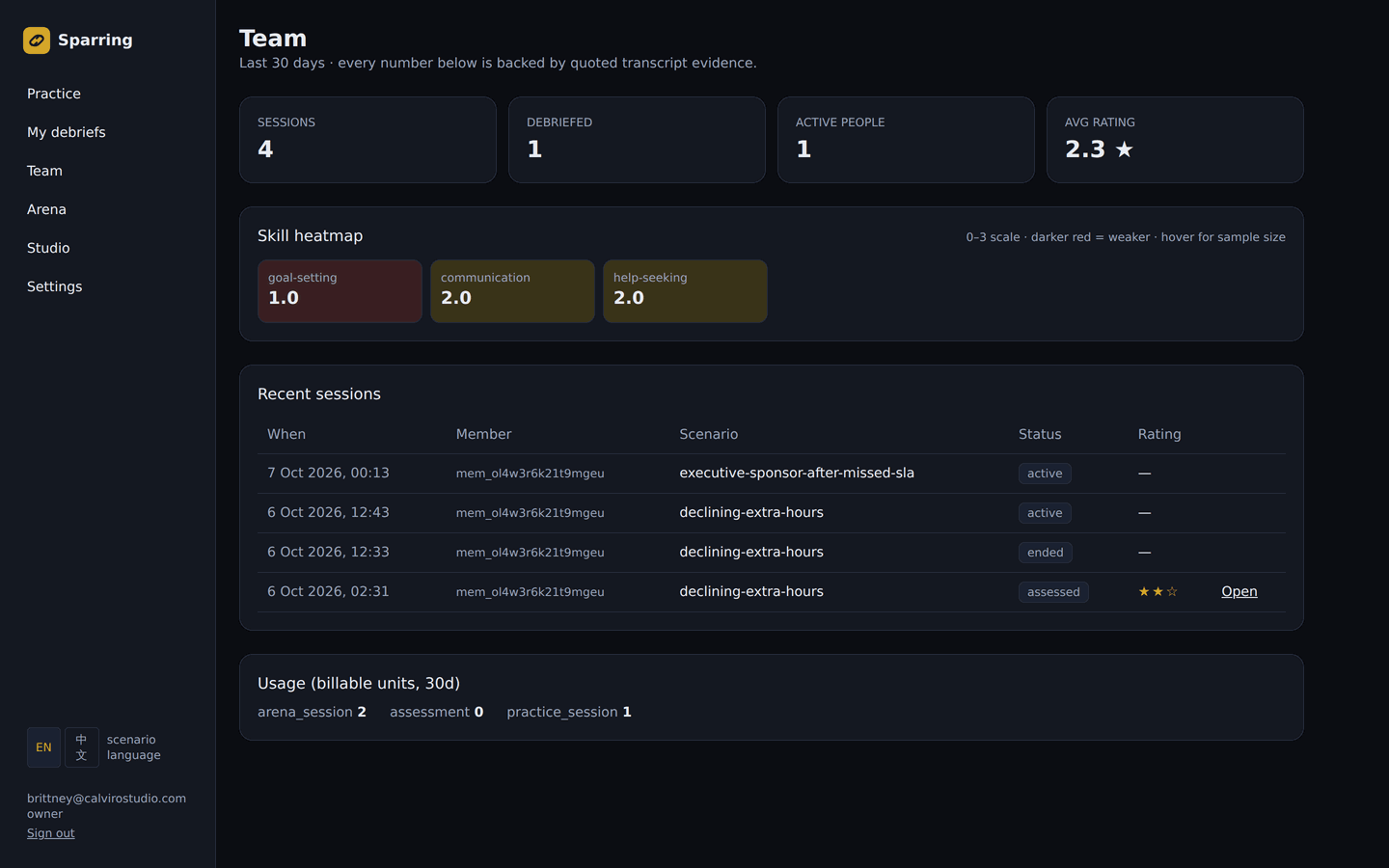
Pilots are scoped to one team and one real problem. We bring the counterparts; you bring the policy. By week four you have a baseline heatmap and a decision.
- 01Week 1 — new-manager cohort or one leadership team; pick the four conversations they most avoid
- 02Week 2 — every manager completes the core scenarios; baseline heatmap (team-level only, per your transparency policy)
- 03Week 3 — pair managers on their weakest skill; HRBPs use debriefs in coaching
- 04Week 4 — re-baseline; roll into the manager onboarding path
Frequently asked
Will managers feel surveilled?+
Is this for new managers only?+
Can we add our own situations — e.g. our performance process?+
Does the counterpart ever break character to coach?+
Give your next manager cohort the reps before the real thing.
A four-week pilot with one cohort produces a baseline heatmap and ten practised conversations per manager.