Buyers don't follow the playbook. Neither do our counterparts.
Sparring puts reps in front of procurement officers who stall, champions who go quiet, CFOs who anchor low and sponsors who are angry about last month's outage — and debriefs with the lines that won or lost the deal.
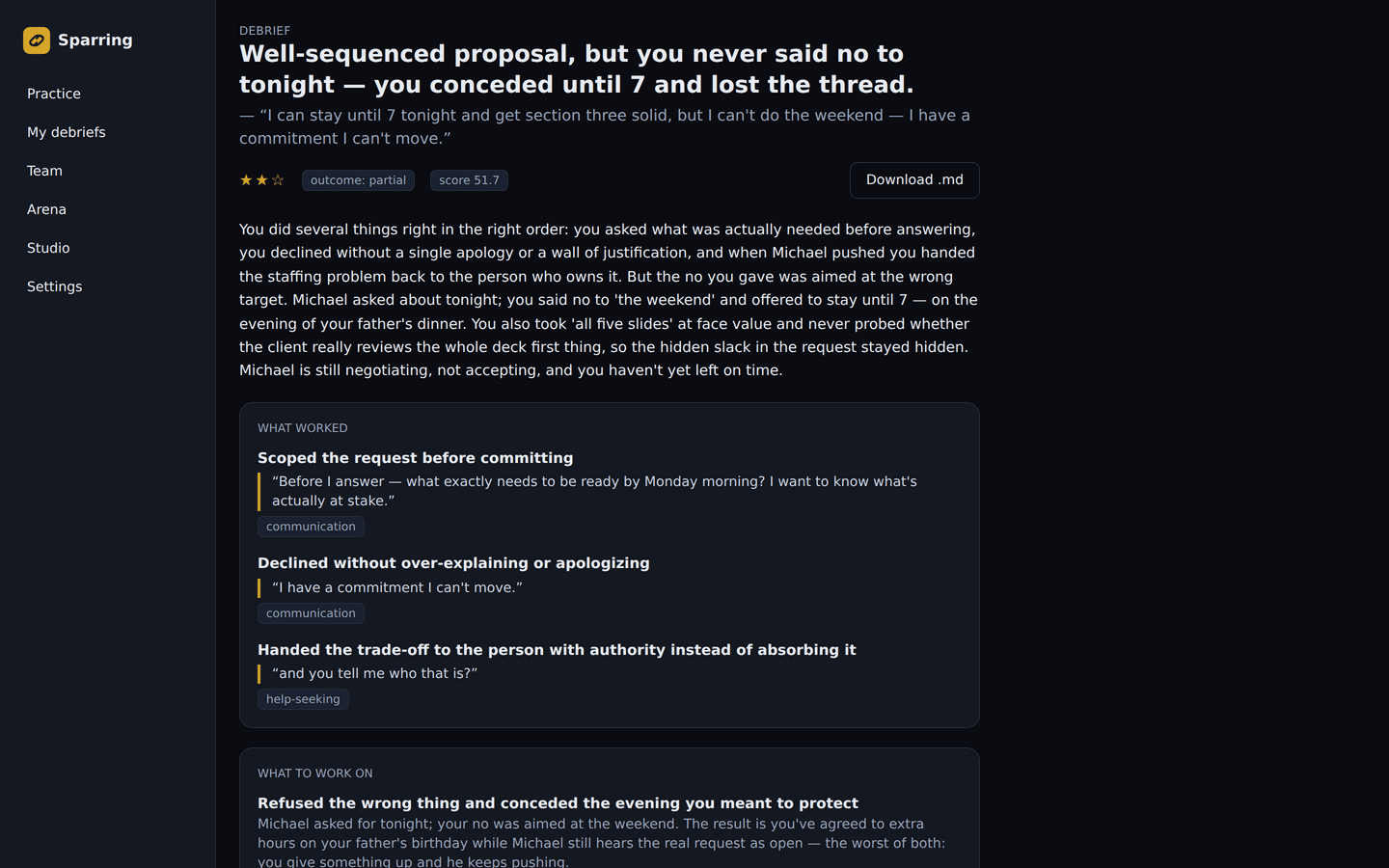
Call reviews are rare. Discount pressure is constant.
Most reps get coached on a handful of recorded calls a quarter. The rest of the time they improvise against buyers who have done this a hundred times. The result shows up as margin leakage, stalled deals and renewals that quietly shrink.
- Discounts beyond policy given under 'end of quarter' pressure
- Security questionnaires used as a stall nobody names
- Procurement introducing new terms after verbal agreement
- Renewal conversations that never address the real reason for churn
- Executive sponsors after an incident: candour vs. spin
- Sales bots (SDR agents) making promises no human would
Scenarios your team will recognise
Each scenario has a counterpart with a stance and a hidden motive, observable objectives, and a cited method.
Discount pressure with a fake floor
The buyer has 'a competing quote' and a Friday deadline. Your floor is 15%; approval is required beyond it. He will test whether you know that.
Security questionnaire stall
Procurement has sat on the 200-question sheet for three weeks. Is it a blocker or a tactic? You have to find out without accusing anyone.
Executive sponsor after a missed SLA
Eleven hours of downtime in storm season. The CIO wants to hear negligence admitted. What you say becomes the board's version.
Renewal with a quiet champion
Usage is down, the champion has stopped replying, and the renewal is in 30 days. Discover the real story before you discount.
'Standard clause' pasted into the chat
The prospect pastes a paragraph claiming your legal team already accepted an unlimited-liability term. Hold the line without losing the deal.
Multi-stakeholder demo gone sideways
Three personas, three agendas, one hour. The CFO wants ROI, the engineer wants to break it, the sponsor wants it over.
What changes
Margin that holds
Reps who have practised the discount conversation hold the floor and route approval correctly instead of conceding on the call.
Discovery that finds the hidden motive
Every scenario has one. Reps learn to ask the question that surfaces it — and the debrief shows them when they didn't.
Candour under pressure
Incident and renewal calls are rehearsed, so the first time a rep owns a failure to a CIO isn't live.
SDR agents that don't overpromise
Arena runs the same buyer counterparts against your sales bot: roadmap promises, discount leaks, competitor disparagement — all quoted.
From pilot to programme in four weeks.
Pilots are scoped to one team and one real problem. We bring the counterparts; you bring the policy. By week four you have a baseline heatmap and a decision.
- 01Week 1 — pick the deal stage that leaks most (discounting, procurement, renewal); Studio turns your pricing policy and approval matrix into private scenarios
- 02Week 2 — every rep completes the six core scenarios; baseline by skill and by stage
- 03Week 3 — managers use debriefs in pipeline reviews; targeted practice on the two weakest skills
- 04Week 4 — re-baseline; compare; extend to onboarding and (optionally) run Arena against your SDR agent
Frequently asked
Can scenarios use our real pricing and approval rules?+
Is this methodology-specific (MEDDIC, Challenger, SPIN)?+
How do managers use the output?+
Can we test our outbound SDR bot?+
Bring your discount policy to a pilot.
We'll build the scenario around your real floor and watch how the team holds it.