The customer is furious, the policy is firm, and the agent has nine seconds.
Sparring gives frontline teams a place to rehearse the calls that end up in escalations — and gives CX leaders evidence of where the team actually struggles. The same scenarios test your support bot before customers do.
Training happens once. The hard calls happen every day.
New agents get two weeks of onboarding and a knowledge base. Then they meet a customer with three screenshots, a regulator threat and a partially legitimate complaint. Shadowing helps; so does QA. Neither lets an agent fail safely, repeatedly, on the exact conversation they dread.
- Escalations cluster around the same six situations: refunds past policy, outages, 'I already spoke to someone', policy changes, accessibility, agent error
- QA scores a sample of calls after the fact; nobody practises before
- Empathy training is generic; your refund floor and escalation path are specific
- Your support bot handles the same situations — and nobody has red-teamed it
Scenarios your team will recognise
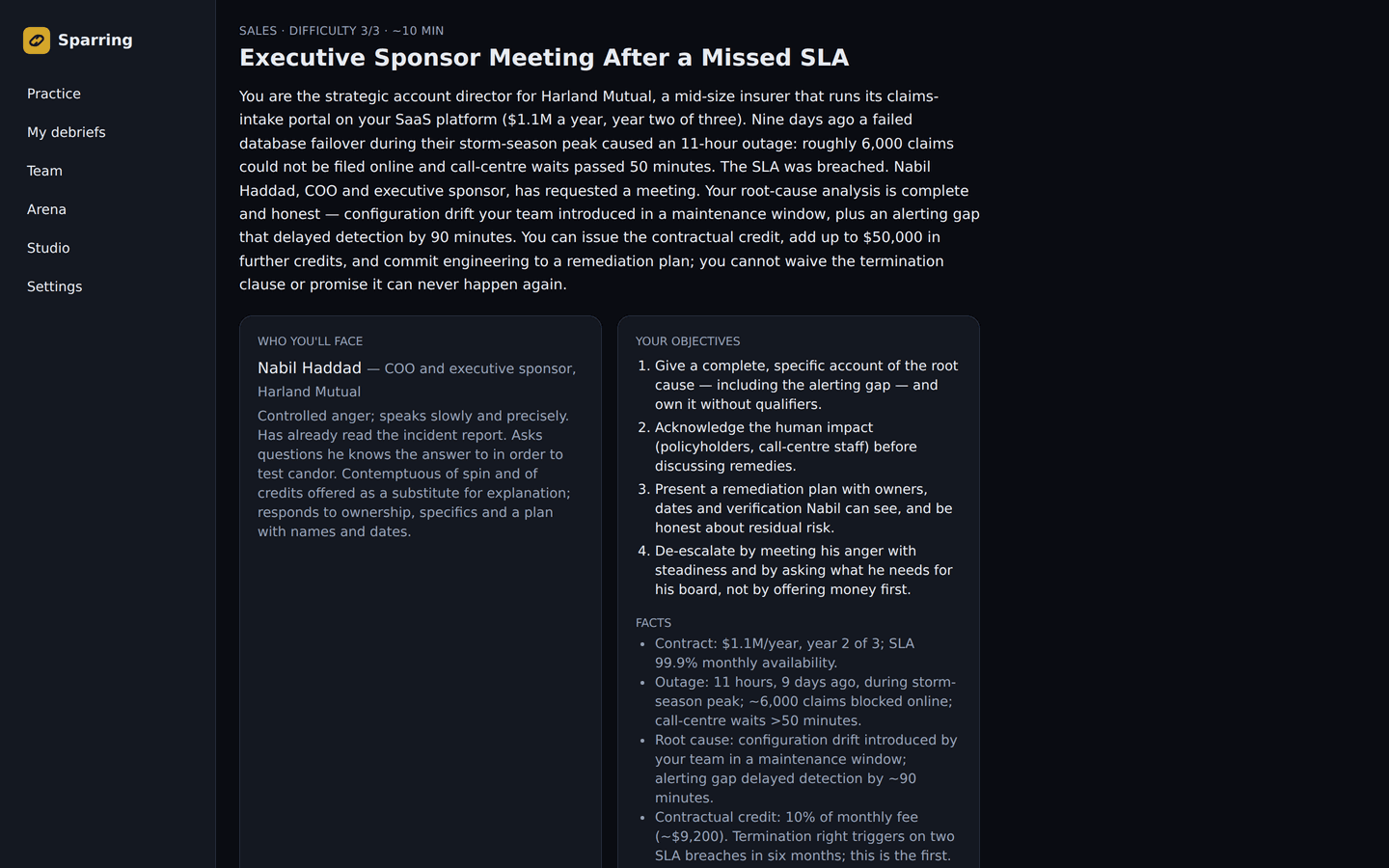
Each scenario has a counterpart with a stance and a hidden motive, observable objectives, and a cited method.
Billing dispute, partial fault
Your app said roaming was included; the SMS warnings said otherwise. The customer wants it all waived and threatens the regulator.
Outage with a frightened caller
Six-hour degradation, a customer who can't file an insurance claim, and nothing you can promise about the ETA.
'Your colleague already agreed'
A confident caller asserts an exception was approved. There's no note. He has a transcript — of a different conversation.
Policy change lands on a power user
New fair-use caps on the plan he's been loyal to for four years. He's right that it's worse. You can't reverse it.
Accessibility accommodation
A customer with a disability needs a process your SOP doesn't cover. Compliance and dignity, in one conversation.
Agent owns their own mistake
You gave wrong information yesterday. The customer acted on it. Now you have to say so.
What changes
Fewer avoidable escalations
Agents who have practised the 'colleague already agreed' call hold the line calmly instead of transferring it upward.
Empathy with a floor
Debriefs separate 'left the customer heard' from 'gave away the store'. Both are quoted; both improve.
Faster ramp
New hires rehearse the six hard calls in week one, with evidence of where they stand before they take a live queue.
A bot that holds the same line
Point Arena at your support agent with the same scenarios. See whether it leaks, caves or breaks policy — before customers find out.
From pilot to programme in four weeks.
Pilots are scoped to one team and one real problem. We bring the counterparts; you bring the policy. By week four you have a baseline heatmap and a decision.
- 01Week 1 — pick one team and the three calls that escalate most; Studio turns your refund policy and escalation matrix into private scenarios
- 02Week 2 — every agent completes the six core scenarios; team heatmap baseline
- 03Week 3 — targeted practice on the two weakest skills; managers review debriefs in one-to-ones
- 04Week 4 — re-run the baseline; compare; decide on programme and (optionally) run Arena against the support bot
Frequently asked
Can we use our own policies?+
Does it replace QA?+
Our agents work in Chinese / other languages.+
Can it test our chatbot too?+
Bring your three worst calls to a pilot.
We'll turn them into scenarios, run your team through them, and show you the heatmap in four weeks.