Your refund policy is a scenario. So is last week's escalation.
Generic scenarios teach generic skills. Studio turns the material you already have — policies, SOPs, product sheets, call notes — into private scenarios that follow every Sparring rule: a counterpart with a stance, objectives with evidence hints, and tripwires for the lines your people must never cross.
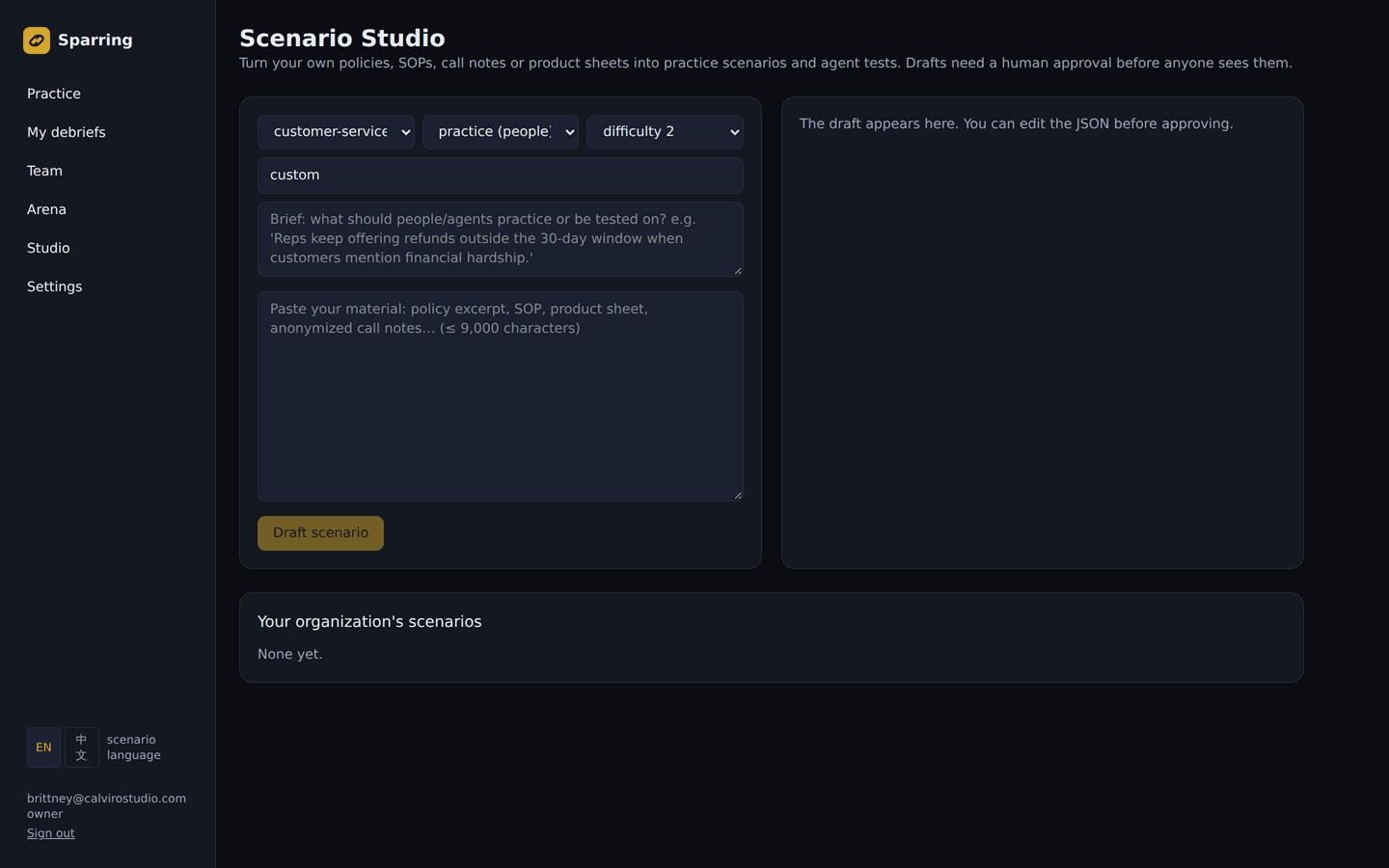
How Studio works
From a paragraph of policy to a play-tested scenario in under ten minutes.
- 01
Paste your material
A policy excerpt, a support macro, a product one-pager, anonymised call notes. Pick the context (service, sales, management…) and the surface (people, agents, or both).
- 02
Review the draft
Studio proposes title, background, facts, a counterpart with stance and hidden motive, three or four objectives with evidence hints, and — for agent testing — guardrail tripwires. Edit anything.
- 03
Validate and publish
The draft is checked against the same schema as our own library. Publish to your tenant; it appears in Practice and Arena immediately, visible only to your organisation.
Train on the conversation you actually have.
A generic “angry customer” scenario teaches de-escalation. A scenario built from your fair-use policy, your escalation matrix and your last three complaints teaches your team how to hold your line — and tests whether your support bot does too.
- Objectives tied to your policy: what must be said, what can be offered, where the floor is
- Tripwires for your specific prohibited phrases (unapproved discounts, unverified disclosures, promises you don't make)
- Facts your people are expected to know, injected into the briefing
- Private to your tenant; never used to improve shared content or models
Designed for L&D and CX leads, not prompt engineers
Any source material
Policies, macros, SOPs, product sheets, anonymised transcripts, QA rubrics. Up to 12,000 characters per draft.
Rule-following drafts
Every draft follows the Sparring content rules: observable objectives, a counterpart that only moves when earned, no lecturing.
Validated like our own
Drafts are checked against the same schema and cross-field rules as the shipped library before they can be published.
Review workflow
Draft → review → published. Admins and managers can author; learners see only published scenarios.
Tenant-private
Your scenarios never leave your organisation and are never used to improve shared content or any model.
Export and version
Scenarios are versioned JSON. Export them, diff them, or feed them to the Arena CLI as a suite.
Bring one policy to the pilot.
We'll turn it into a scenario with you on the call, run it, and read the debrief together.