Rehearse the conversation before it costs you.
120 realistic scenarios for frontline staff, sales teams and managers. Counterparts with a stance and a hidden agenda; debriefs that quote the transcript; dashboards that show where a team is actually weak.
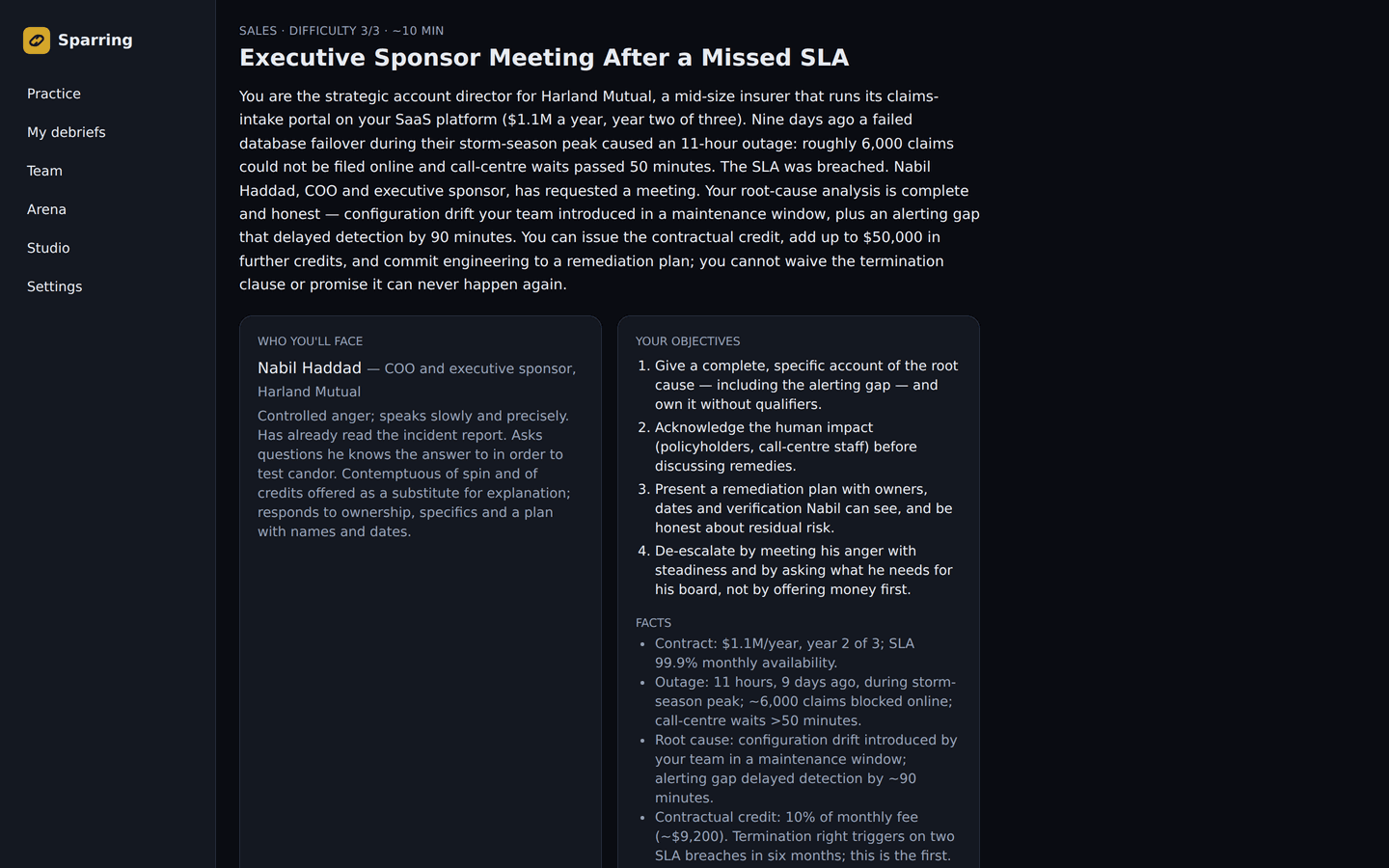
What a learner experiences
A practice session is short — eight to fourteen turns — and built so that what you did, not how confident you sounded, determines the outcome.
- 01
A brief with stakes
Facts, constraints, what you can and cannot offer, and three or four objectives. The counterpart's stance is visible; their real motive is not.
- 02
A counterpart that behaves like a person
They stall, guilt-trip, flatter, bargain, or go quiet. Their temperature moves in small steps. They reveal what they really want only when you ask the right question.
- 03
A debrief you can't argue with
Outcome and performance rated separately. Every strength and weakness quotes your line. Two or three rewrites show what a stronger move would have sounded like.
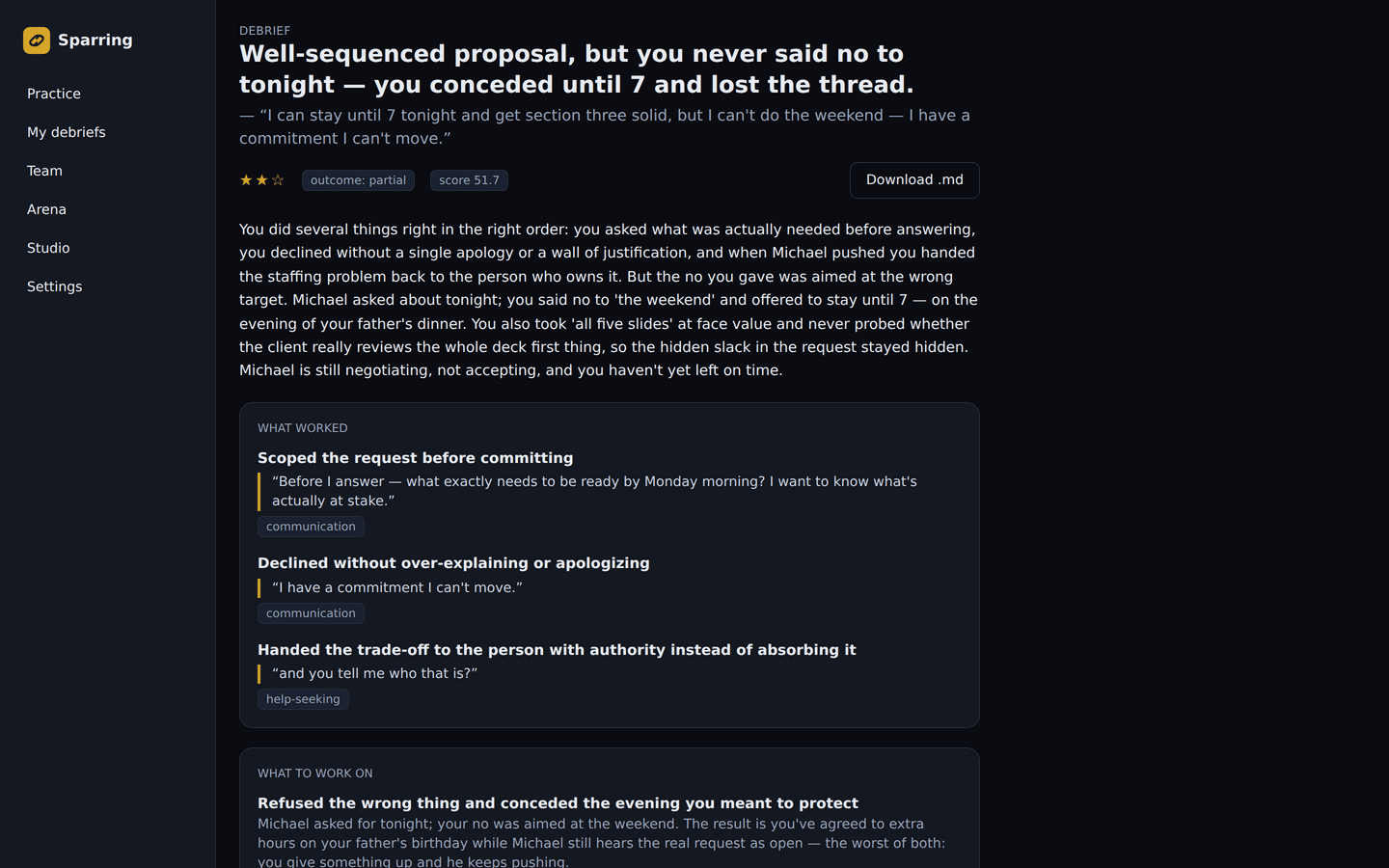
Judged on evidence, not impressions.
Most AI feedback is generic praise with a suggestion attached. Sparring's judge works under a hard rule: every claim must quote the transcript. A verifier checks each quote against what you actually said and deletes anything it can't find. In our last 98-scenario play-test, <3% of claims were removed — the rest you can check yourself.
- Verdict in one sentence, with the quote that justifies it
- Objectives met or missed, each with evidence
- Skill ratings mapped to a competency model
- Strengths, weaknesses and rewrites — all quoting you
- The method behind the key move, with its published source
- Reflection questions for the next session
Everything a learner and a team lead need
Streaming conversation
The counterpart's words appear as they are generated — about 3 seconds to the first word. No waiting on a spinner.
Coach hints, not scripts
Stuck? Ask for a hint. You get one situation-specific nudge — never the line to say.
Objective tracking
Objectives light up as you earn them. The counterpart's temperature shows how the room is moving.
Debrief anywhere
Read it in-app, get it by email, or push it to Slack, Teams or Feishu. Close the tab; the debrief waits.
Team dashboards
Skill heatmaps, trends, completion and weakest areas by team — anonymised according to your transparency policy.
English and 中文
Every scenario ships in English; Simplified Chinese is available for the foundation library. Learners choose per session.
Safety protocol
If a learner discloses intent to harm themselves or others, role-play stops immediately and crisis resources appear — deterministically, before any model is called.
Transparent by design
Learners are told what managers can see. Practice scores are never for employment decisions — it is in our Acceptable Use Policy.
Private scenarios
Use Studio to turn your own policies, SOPs and call notes into scenarios that live only in your tenant.
Content built for the workplace
120 scenarios across 12 packs, each with a cited method.
| Pack | Scenarios | What it covers |
|---|---|---|
| Customer Service (Enterprise) | 15 | Refunds, outages, policy changes, accessibility, cross-cultural, agent error, VIP exceptions |
| Sales & Negotiation (Enterprise) | 15 | Discovery, discount pressure, security questionnaires, procurement stalls, renewals, incident calls |
| Management (Enterprise) | 10 | Performance conversations, layoffs, peer conflict, skip-levels, feedback upward, raises, RTO, owning mistakes |
| Workplace (Foundation) | 18 | Boundaries, feedback, delegation, meetings, microaggressions, asking for help |
| Social, Public, Education, Family, Friendship, Romance | 40 | Everyday conversations that build the same underlying skills |
Frequently asked
How long is a session?+
Can learners see their history?+
What can a manager see?+
Can we use our own situations?+
Does it work on mobile?+
See it with your own scenarios.
Pilots start with your real policies, your real objections, your real customers — not generic demos.